Issue 23

International Research Cooperation on TVET

Editorial Issue 23: International Research Cooperation on TVET

Editorial Issue 23: International Research Cooperation on TVET

Full issue 23

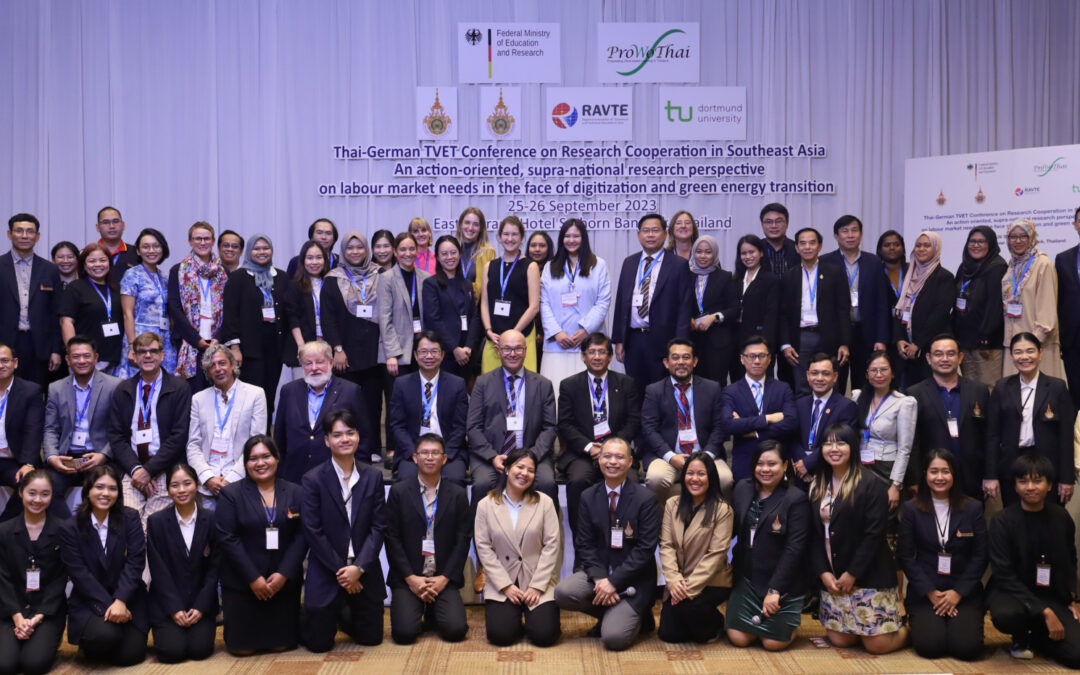
In recent years, research on technical and vocational education and training (TVET) has become increasingly vital for developing TVET systems and is recognized by political stakeholders. However, challenges persist in building research capacities at universities and research institutes. Encouragingly, Southeast Asia has seen the establishment of several TVET research institutes like MyRIVET in Malaysia, the TVET Research Center at RMUTL in Thailand, and PUI TVET-RC at Universitas Pendidikan Indonesia, which support both national objectives and international cooperation in TVET research. The Thai-German TVET Conference on Research Cooperation in Southeast Asia, held from 25-26 September 2023 in Bangkok and organized under the BMBF-funded project “Progressing Work-based Learning in Thailand (ProWoThai)”, was pivotal in advancing international TVET research. The conference built on collaboration with the European Training Foundation, UNESCO-UNEVOC, and BIBB, strengthening research ties between Asia and Europe and providing a platform for TVET researchers, practitioners, industry representatives, and policymakers from Southeast Asia and beyond to share their insights on research cooperation.

read more

About TVET@Asia


TVET@Asia is an open content online journal for scientists and practitioners in the field of Technical and Vocational Education and Training (TVET) and Vocational Teacher Education (VTE) in the East and Southeast- Asian region.

Its main purpose is to provide access to peer reviewed papers and thus to enhance the dissemination of relevant content and the initiation of open discussions within the TVET community.

Industry and Vocational School Collaboration: Preparing an Excellent and Industry-Needed Workforce

Mismatch still occurs between vocational schools and industry, where vocational high schools/Sekolah Menengah Kejuruan (SMK) contribute to the highest unemployment rate compared to elementary school/Sekolah Dasar (SD), Junior High School/ Sekolah Menengah Pertama (SMP), Senior High School/Sekolah Menengah Atas (SMA) and University in Indonesia. This remains a challenging phenomenon, amidst national regulations mandating SMK to be educational institutions that prepare graduates for employment. This article aims to examine the appropriate learning patterns that synchronize the needs of industry with the implementation of learning in schools. The method used in writing this article is Systematic Literature Review (SLR), limiting sources to the past 10 years from nationally and internationally indexed journals. Industrial education with collaboration between industry and SMK is the solution in preparing graduates as a competitive and industry-relevant workforce. This pattern can be used to map industry needs by employing a realistic learning approach aligned with industry practices, considering the rapid and massive changes and shifts in the industry.

read more

International experiences in TVET training as a catalyst for cooperation in training – Insights from TVET Vietnam

Shortages in recruiting skilled workers have made many Foreign Direct Investment companies (FDI) in Vietnam engage with training at the workplace. Training on the job has become a highly effective solution in TVET Vietnam. It has, however, been considered an informal learning model concerning Vietnam TVET law, applied mostly in the logistics and engineering branches. Besides efforts from industry, TVET Vietnam has also received support from partner countries via foreign agencies such as JICA from Japan, KOICA from South Korea, GIZ (German development agency), and DIHK from Germany, which research on human resources and the impact of labour force quality on industry’s skills demand. This is in order to give advice concerning TVET policies or provide solutions for bridging gaps between TVET stakeholders, such as strengthening cooperation in training via the development of a dual training model or a tripartite model between vocational schools and enterprises as well as promoting TVET trainers and teachers’ training in order to upgrade their qualifications and acknowledge informal training.

read more

Exploring Effectiveness of Hands-on Activities of Technical Students in Cambodia

This study explored the effective hands-on activities of technical education students in Cambodia. Specifically, it investigated key hands-on activities and the level of effective hands-on activities of 205 technical education students. This study used a quantitative method employing a cross-sectional survey design and a factor analysis approach with Principal Component Analysis (PCA). Descriptive statistics were used to examine the data acquired using SPSS version 25, which provided the frequency count and percentage of responses. Moreover, the level of effective hands-on activities of technical education students revealed a high level of proficiency in procedures and steps, creativity, skill incorporation, immediate application, and a moderate level of skill in competition. The results revealed that the effective hands-on activities of technical education students are multidimensional and explore five factors: proficiency in procedures and steps, creativity, skill incorporation, being skilled in competition, and immediate application.

read more

Developing the Tripartite Education System for the ASEAN Region: A comparative analysis of three variants of the School-in-Factory program at the Rajamangala University of Technology Lanna

This study aims to further develop research on the Tripartite Education System (TES) for Thailand and the ASEAN region. The collaboration between governmental agencies, industries and education institutions (universities, technical colleges) in a Public-Private Partnership (PPP) has proven to be of benefit in achieving a workforce able to cope with the challenges of the labour market in an Industry 4.0 environment. However, there is still debate on how to organize the PPP specifically. This essay gives some insights into three variants of the Thai School-in-Factory (SiF) model implemented at the Rajamangala University of Technology Lanna, which will be called Collaboration A, Collaboration B and Collaboration C. The analyses are done by reviewing existing documents on the projects (such as Memorandums of Understanding), and the review will show similarities and differences in collaboration structure, elements and concepts, objectives, roles of educational institutes and industries, curriculum, and finally, criteria and processes for student selection.

read more

Inclusive education practices in TVET institutions in Botswana, South Africa and Thailand: A systematic review

This study collects data on inclusive education practices within Technical Vocational Education and Training (TVET) institutions across Botswana, South Africa, and Thailand. Utilising a systematic review methodology, the research examines international policies, government reports, and peer-reviewed journal articles relevant to inclusive education in the TVET sector. The objective is to present an overview of current practices, policies, and guidelines, assess the provision of inclusive facilities and amenities in these institutions, and identify the challenges encountered. Despite inclusive education policies in the three countries, the TVET sector continues to inadequately address the diverse inclusive needs of students and other stakeholders. TVET facilities in these nations remain systemically segregated, thereby excluding individuals with special needs. The literature indicates that effective inclusive practices depend more on the institutional implementation of inclusive processes than students’ abilities. The findings reveal gaps in both policy and practice, highlighting that many TVET teachers lack training in inclusive education pedagogies.

read more

Establishing an IoT-Vocational Learning Center: A project to investigate the benefits of emerging technologies

This study has three main goals: (1) to create a prototype Internet of Things (IoT) technology learning center that focuses on the community, (2) to design an IoT learning module, and (3) to establish a maintenance center. The development of the IoT learning center is an excellent example of how emerging technologies can revolutionize learning methods and enhance educational efficiency. The study covers both hardware and software and follows the structured ADDIE model for instructional design. It ends with a modern prototype for an open farming system that benefits local farmers and elderly residents in Chiang Rai province. The study uses an agile model to manage multiple stakeholders and meet time-sensitive deadlines. The project was carried out in collaboration with Chiang Rai Vocational College of Information Technology students, Chiang Rai Provincial Department of Education staff, and a community of elderly farmers. The system was designed for a private cloud-based server. The resulting smart device prototype facilitates wireless control of agricultural processes via a centralized unit, transmitting data to the cloud for monitoring through a dedicated mobile application.

read more

No Results Found

The page you requested could not be found. Try refining your search, or use the navigation above to locate the post.

No Results Found

The page you requested could not be found. Try refining your search, or use the navigation above to locate the post.

No Results Found

The page you requested could not be found. Try refining your search, or use the navigation above to locate the post.

No Results Found

The page you requested could not be found. Try refining your search, or use the navigation above to locate the post.

No Results Found

The page you requested could not be found. Try refining your search, or use the navigation above to locate the post.

No Results Found

The page you requested could not be found. Try refining your search, or use the navigation above to locate the post.

No Results Found

The page you requested could not be found. Try refining your search, or use the navigation above to locate the post.

No Results Found

The page you requested could not be found. Try refining your search, or use the navigation above to locate the post.

No Results Found

The page you requested could not be found. Try refining your search, or use the navigation above to locate the post.

Call for Papers:

Issue 28: Bridging the Skills Gap: Industry–TVET Partnerships for Workforce Readiness

TVET@Asia invites researchers, scholars, practitioners, and policymakers to contribute to a special issue focused on the theme of Bridging the Skills Gap: Industry–TVET Partnerships for Workforce Readiness.

Scope and Objective:

The rapid acceleration of digitalization, the transformative influence of artificial intelligence (AI) and robotics, the transition toward a green economy, and the volatility of global markets have created an urgent need for a workforce capable of adapting through continuous skill expansion and professional development. As industry requirements evolve more rapidly than traditional curricula, the synergy between Technical and Vocational Education and Training (TVET) and the industrial sector has become a strategic imperative. To ensure genuine workforce readiness, we must move beyond superficial cooperation toward deep, systemic partnerships.

Sustainable industry-TVET partnerships require alignment across multiple dimensions. At the institutional and legal level, public-private partnerships must be grounded in clear obligations and mutual requirements. Curricula must integrate the evolving competences demanded by industry, while teaching and learning methodologies should mirror actual workplace conditions. Furthermore, TVET institutions require the necessary infrastructure to support high-quality work-based learning, and educators must maintain an up-to-date understanding of industrial production processes to deliver industry-driven skills. Achieving these goals requires structured communication frameworks to facilitate continuous exchange between all stakeholders.

This issue aims to examine the various dimensions of industry-TVET partnerships in promoting workforce readiness. We invite original research papers, conceptual and theoretical works, policy-focused studies, and practical case analyses that investigate how established private-public partnerships can close the skills gap and enhance employability. Contributions may also provide critical reflections on policies, models, innovations, and the broader impact of these partnerships on learners, industries, and communities.

Potential areas of interest include, but are not limited to:

  • Co-Curriculum Development: Strategies for agile curriculum design involving industry stakeholders to ensure alignment with real-world labor market needs.
  • Work-Integrated Learning: Evaluation of dual-education systems, apprenticeships, and internship models that effectively transition students from classroom to workplace.
  • Teacher & Trainer Professionalization: Models for "industry-to-classroom" knowledge transfer and the continuous upskilling of TVET instructors.
  • Policy & Governance: Analysis of public-private partnership frameworks that incentivize industry investment in vocational education.
  • Inclusive Readiness: Ensuring that TVET partnerships address equity, diversity, and the inclusion of marginalized groups in the modern workforce.

This issue is intended to serve as an important reference and knowledge platform for educators, industry stakeholders, researchers, and policymakers who are dedicated to strengthening TVET’s role in bridging skills gap and promoting work readiness.

Submission Guidelines:

Authors are invited to submit their original manuscripts following the guidelines provided by TVET@Asia Online Journal. All submissions will undergo a rigorous peer-review process to ensure the quality, relevance, and originality of the research. Manuscripts should be written in English and adhere to the journal's formatting and citation style.

Please note that the journal does not provide language editing or copyediting services. Authors are therefore responsible for ensuring that their manuscripts are written in clear and correct English prior to submission. Authors are encouraged to carefully check grammar, spelling, and language quality before submission and may consider using professional language editing services or AI-supported writing tools where appropriate.

We welcome submissions from any interested authors!

We look forward to receiving your contributions!

Please find below:

    Editors of Issue 28

    These are the editors of our upcoming TVET@Asia issue:

    Adeline Goh Yuen Sze (University of Brunei Darussalam)

    Philipp Grollmann (TU Dortmund University)

    Siriphorn Schlattmann (Rajamangala University of Technology Lanna)

    Lee Ming Foong (Tun Hussein Onn University of Malaysia)

    Become an Author

    This Call for Papers is open to any interested author.

    We invite scholars, scientists, curriculum developers, practitioners and teachers from the TVET community to contribute to the upcoming Issue 28 of TVET@Asia. 

    We look forward to receiving your contributions!

    TIMELINE

    "

    Submit Your Abstract

    by August 30th, 2026

    To participate we ask you to send us the following documents:

    1. an abstract of no more than one page (please download this form),
    2. a short CV/profile (half page),
    3. a photograph of yourself, and
    4. a list of publications

    Please submit your work via E-Mail:

    "

      Abstract Notification

    by September 11th, 2026 you will be informed whether your abstract has been accepted.

    "

    Paper Submission

    Please use this article template to submit your paper.

    The full draft paper should be submitted until: October 20th, 2026.

    "

    Peer Review

    Notification of acceptance and peer review feedback by November 27th, 2026.

    "

    Final Submission

    Submission of the final, correctly-formatted paper by January 8th, 2027.

    "

    Publication

    Tentative publication date: February 12th, 2027.

    Sign up for our Newsletter

    Here you can subscribe to our newsletter! Through the newsletter we will inform you about new Calls for Papers, the publication of new issues of TVET@Asia as well as the latest publications and events in the field of Technical and Vocational Education and Training.

    Here you can subscribe to our newsletter! Through the newsletter we will inform you about new Calls for Papers, the publication of new issues of TVET@Asia as well as the latest publications and events in the field of Technical and Vocational Education and Training.

    Subscribe To Our Newsletter

    Subscribe To Our Newsletter

    Join our mailing list to receive the latest news and updates from our team.

    You have Successfully Subscribed!